minimizeApplications


» print page

Atomic Absorption Spectroscopy (AAS)

AAS-cuvette2.jpg
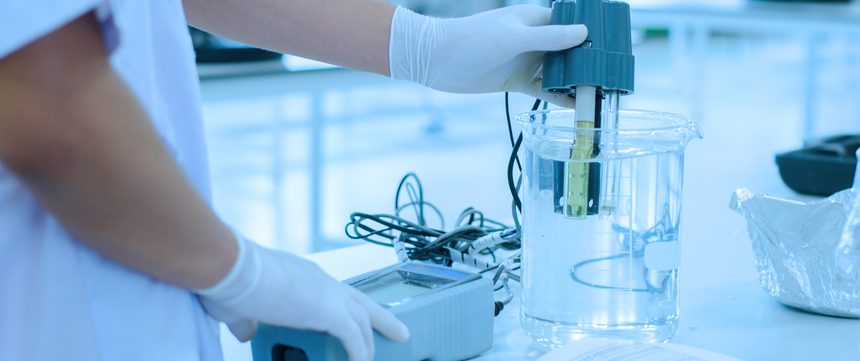
Atom absorption spectroscopy (AAS) is the most widely utilised method today for rapid and quantitative element analysis. The detection limit in this case lies at up to 0.1 ppt (1 billionth) under optimum test conditions. A material sample (in a liquid solution) is atomised through rapid heat application and placed in the radiation path of several element-specific light sources. The atoms absorb the wavelength corresponding to their excitation energy, thus reducing the radiated energy. The concentration of the element to be analysed can be determined with the aid of the Lambert-Beer law through wavelength dispersive measurement of this reduction.

Three principle atomising methods are employed, namely the flame technique (F-AAS), graphite tube technique (GF-AAS) and hydride technique (CV-AAS). The solvent is initially vaporised in each case, prior to pyrolisation of the organic components and subsequent dissociation of the solid material. The dissolved sample is dispensed to the flame as an aerosol in F-AAS. This procedure is characterised by a detection accuracy reduction of three decimal power factors when compared with the improved GF-AAS technique. The hybrid technique is suitable for elements that form volatile hydrides (Sn, As, Sb, Se, etc.). The procedure involves the introduction of the hydrides to an argon current in a heated cuvette made of quartz glass or graphite where they degenerate and can be analysed. The graphite tube technique involves the pyrolysis of a precisely dispensed sample in a graphite tube which, due to its electrical resistance, heats when an electrical current is applied. Considerable advantages when compared to the flame technique are achieved through two effects. On the one hand, the sample is added quantitatively and with a longer dwelling time in the radiation path. On the other hand, interfering matrix components can be effectively separated through different vaporising temperatures.

As vaporising must occur very rapidly and in a precisely defined temperature-time window, thermal conductivity and electrical resistance are decisive parameters in the vaporising unit. As maximum possible purity is also required (as only then can the high detection limits be realised), ultra-pure graphite is used for the vaporiser which is additionally coated with pyrocarbon or pyrographite, depending on the functional principle and measuring apparatus involved.

minimizeMaterials (3)

minimizeMultimedia (2) 

maximizeDialog board